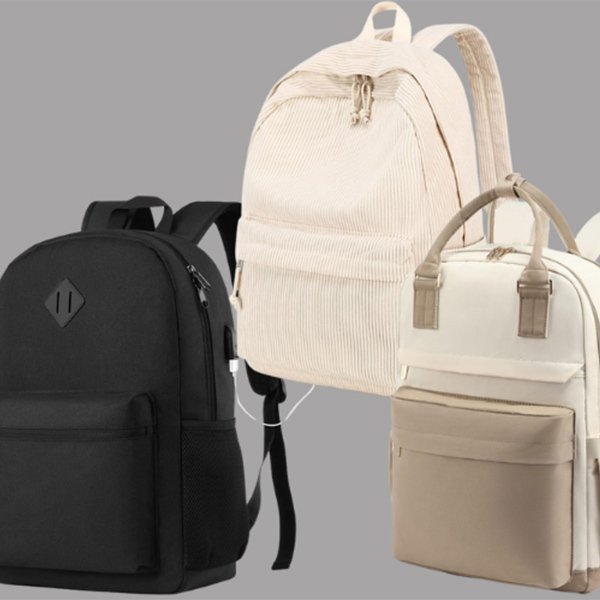
What are the standard backpack sizes? In the backpack industry, 20-30 liters is generally considered the standard size range for everyday backpacks. A 30-liter everyday backpack is a good size, meeting basic storage needs without requiring additional reinforcement frames or waist belts, suitable for daily use, short trips, outdoor activities, and carry-on items.
However, to meet market and consumer demand, manufacturers typically offer backpacks in various sizes, ranging from 5 liters to 50 liters or even larger. If you want to customize a backpack with just the right capacity, you can use 30 liters as a reference.

Standard Backpack Size Dimensions
well-designed daily backpack balances capacity and ergonomic comfort. Here are some common size ranges:
| Dimension | Metric | Imperial | Notes |
| Height | 45-50 cm | 18-20 inches | Includes top handle; aligns with typical torso lengths |
| Width | 30-35 cm | 12-14 inches | Usually fits up to a 15-inch laptop |
| Depth | 15-20 cm | 6-8 inches | Slim enough for narrow aisles or crowded commutes |
| Capacity | 20-30 L | ~1,220-1,830 cubic inches | Usable internal storage |
It’s important to note that backpack storage capacity typically only includes the main compartment, zippered mesh pocket, and top pocket. Side mesh pouches, shoulder strap pockets, waist belt pockets, and external drawstring points are not included in the capacity measurement. If your backpack includes these extra pockets, the actual usable capacity may be 2-3L larger.
How Do Brands Measure Backpack Capacity?
Most brands use the hydration bladder method to measure backpack capacity. They fill an empty backpack with sealed 1-liter water bags until it’s full, then count how many fit. Due to differences in hydration bladder shape and backpack structure, the method can result in a 5% discrepancy.
Unlike brands, custom backpack manufacturers, including Kewei, use 3D CAD technology to precisely calculate the internal space of the backpack, including fabric thickness and seam allowances, ensuring more accurate measurements.
What Are the Most Common Backpack Capacities for Daily Use?
Everyday backpacks typically fall into three main capacity tiers: 20L for minimal commuting, 30L for school or work, and 40L for those who need extra gear.
20L Backpacks
Size and Weight: The defining feature of a 20L backpacks is their compact size and lightweight design. It measures approximately 18 x 11 x 6 inches and weigh just 0.7 and 1.0 kg.
Design Features: To achieve a slim and lightweight appearance, it typically features a frameless or minimalist internal support design; mesh shoulder straps and back panels for breathability; simple construction with quick-access pockets.
Capacity: Can hold a 13-inch laptop, a light jacket, a mobile phone, keys, and ID.
Suitable for: Minimalist commuters, cyclists, and university students.
30L Backpacks
Size and Weight: Slightly larger than 20L models, measuring approximately 19 x 13 x 7 inches and weighing 1.0-1.3 kg.
Design Features: More diverse organization including padded laptop compartment, secure zippered pockets, side water bottle holders, quick-access front pockets. Wider shoulder straps and hip belts for better weight distribution and comfort.
Capacity: 15-inch laptop, work documents, water bottle, lunchbox, essentials
Suitable for: Office workers, students
40L Backpacks
Size and Weight: With more substantial capacity, these measure around 20×14×8 inches and weigh 1.3-1.6 kg.
Design Features: Utilizes a frame design for optimal support; the structure is more complex, including a main compartment, front pocket, zippered dividers, wet and dry separation pockets, and external attachment systems.
Capacity: Holds 2-3 days’ worth of clothes, toiletries, and sports equipment.
Suitable for: Fitness enthusiasts, parents who need to change diapers, frequent business travelers, and short-trip travelers.
Common Custom Backpack Sizes from Brands
While 20-30 liters is the standard capacity, brands often customize backpacks of different capacities to suit various scenarios and customer needs.
- 18L: Slightly smaller capacity, suitable for storing everyday items like a phone, wallet, and keys, easy to carry, ideal for minimalist commuters.
- 25L: Can hold a 13-inch laptop, lunchbox, and documents, easily fitting into lockers and under desks, suitable for those with a mixed work-life balance.
- 35L: Adds extra space beyond work and personal items for gym gear or overnight essentials like a change of clothes and toiletries—ideal for short business trips or weekend getaways.
Kewei not only offers wholesale standard 20-30L everyday backpacks, but our OEM/ODM services also allow us to customize backpacks according to precise size and quantity requirements specified by customers, meeting the market demands of unique scenarios.
Standard Sizes for Other Backpack Types
Beyond everyday backpacks, different categories have their own standard size conventions:
| Backpack Type | Common Capacity Range | Use Case | What Fits |
| Carry-on Bag | 20-25L | Fits under airline seats | Laptop, documents, charger, passport, snacks |
| Short Trip Backpack | 35-40L | 2-3 day business trips, weekend camping | 2-3 outfits, toiletries, laptop, light snacks |
| Travel Backpack | 40-45L | 3-5 day travel, suitcase alternative | 4-5 outfits, laptop, shoes, toiletries, souvenir space |
| Multi-Day Hiking Pack | 50-70L | 3-7 day hiking, mountaineering camping | Tent, sleeping bag, sleeping pad, stove, food, water, extra layers |
| Technical Climbing Pack | 70L+ | 7+ day expeditions, high-altitude climbing | Full camping kit, technical gear, multi-day food & fuel, emergency supplies |
What Are the Standard Sizes for Youth Backpacks?
The backpacks mentioned above are primarily designed for adults, and their structure and load-bearing capacity may not be suitable for children and teenagers. Overloading can lead to muscle strain, poor posture, and limited mobility. The standard capacity for youth backpack should be 20-30L, designed for torsos 30-38 cm and hip circumferences of 60-80 cm.
To accommodate seasonal clothing and minor growth spurts, high-quality youth backpacks are designed with features such as sliding rails and removable pads to accommodate 5-10 cm adjustable shoulder strap lengths. As an OEM/ODM custom manufacturer, Kewei can customize backpacks based on the body structure of teenagers. For example, adding a waist belt improves the backpack’s fit to the body, and transferring 60%-80% of the backpack’s weight from the shoulders to the hips.

Beyond custom youth backpacks, we also offer custom women’s backpacks as well. Compared to ordinary backpacks, these custom women’s backpacks feature narrow shoulder straps angled towards the chest and load-bearing adjustment straps, with a higher chest strap position and a shorter torso length, allowing the backpack structure to better fit the female body and reduce carrying fatigue.
How to Measure Backpack Size?
For brands working with manufacturers, knowing how to measure backpack dimensions ensures consistency and helps you verify that custom orders meet your specifications.
- Empty the backpack: Remove all items, including detachable pockets. Zip all compartments fasten all buckles, and lay the pack flat on a table with the back panel down and shoulder straps tucked underneath.
- Measure the height:Measure from the bottom seam of the backpack to the highest point of the handles. Use a rigid ruler or tape measure, keeping it flush against the backpack.
- Measure the width: Find the widest part of the backpack(usually near the shoulder straps or side pockets), gently flatten any mesh pockets, and keep the bag level and flush against the backpack to begin measuring.
- Measure the depth: Flatten any pleats on the sides and measure from the front panel to the back panel at the midpoint of the bag’s height. If the bag has roll-up or zippered extension panels, you can fully unfold or compress them to measure the maximum or minimum depth.
- Calculate capacity: Height × Width × Depth (inches) = Cubic inches, then divide by 61 for the approximate volume in liters.
Note that the calculated number should be subtracted by about 5%, as fabric, seams, and internal compartments will take up some space. If the measurement result differs from the manufacturer’s specifications by more than 10%, adjustments need to be negotiated. To minimize errors, Kewei uses CAD technology to accurately measure internal dimensions.
At Kewei, you can customize not only standard backpacks but also custom-sized backpacks based on activity type, such as 15-25L urban backpacks, 30-50L weekend travel backpacks, and 50-70L multi-day adventure backpacks. Furthermore, we can customize expandable designs for you, including roll-top packaging, zip-expand panels, and external attachment points, all of which help expand the backpack’s usable capacity. Ready to start customizing custom-sized backpacks for your brand? From sample making and low minimum order quantities to rigorous quality control, Kewei ensures that your brand’s backpacks exceed your expectations.
FAQ
What is the best backpack size for school?
A school backpack between 18 and 25 liters is the most suitable size. It can hold essential school items such as books, laptops, and stationery, and it’s not too heavy.
How to buy a suitable and comfortable backpack?
To buy a suitable and comfortable backpack, you must learn how to measure your back length. Here’s how to measure your back length:
- Stand upright with your feet shoulder-width apart;
- Place the beginning of the measuring tape at the seventh cervical vertebra (C7);
- Measure downwards with the measuring tape close to your body, up to the top of your iliac crest. The result is your torso length.
What are the standard size for carry-on baggage required by airlines?
Most major airlines enforce a standard carry-on baggage limit of 22 x 14 x 9 inches (approximately 45 liters of external volume).
For personal items — such as backpacks intended to fit under the seat in front of you — the typical maximum dimensions are 18 x 14 x 8 inches, which works out to roughly 20–25 liters.
What materials should be used for custom backpacks larger than 40L?
For custom backpacks with larger capacity and size, prioritize lightweight fabrics, such as 200-400D nylon or polyester. These not only offer durability but also make the backpack lighter.
Ready to Customize Your Backpacks?
Now that you understand standard backpack sizes, here are more helpful guides to help you plan your project:
- Low MOQ Custom Backpacks: Perfect for New Brands Testing the Market
- How to Find a Reliable Bag Manufacturer in China
Contact us today for a free consultation and custom quote.