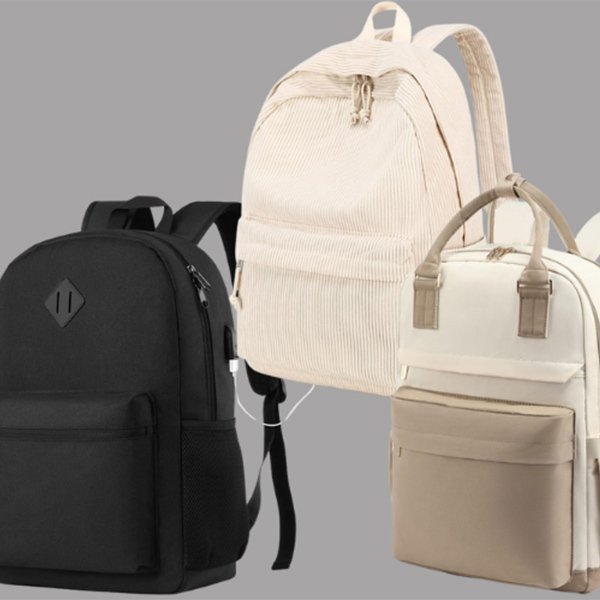
Polyester is a synthetic fiber made from petrochemical raw materials through a melt-spinning process. Due to its readily available properties, it’s highly sought after and widely used in backpack manufacturing. Common backpack styles, such as fashion backpacks, tote backpacks, and promotional gift backpacks, all both use the polyester fabric. Many customers like its’ diverse styles and vibrant colors.

Classification
Polyester has two categories: polyester staple fiber and polyester filament. These two categories differ slightly in their production processes and appearance.
Polyester staple fibers, after melt spinning, stretching, crimping, and cutting into short segments, are spun into yarn like cotton fibers. The surface of polyester staple fibers is fuzzy, similar to cotton fibers.
Polyester filaments, after melt spinning and high-speed stretching, can be directly woven into fabrics without cutting. Therefore, polyester filaments have a smoother surface and higher luster.

Advantages
Now that we understand how polyester is made and its classifications, let’s explore the advantages of polyester and why it’s so popular as a backpack material.
Waterproofness
Polyester itself isn’t waterproof. It’s a synthetic fiber with a low affinity for water, and because the fiber itself has pores, water can seep through these gaps. With advancements in technology, coated polyester has become more water-resistant than materials like canvas and nylon. It makes it a popular material for outdoor backpacks, effectively withstanding unpredictable weather and preventing sweat from seeping into the interior.
Durability
Polyester has a certain tensile strength, making it tear-resistant and abrasion-resistant, making it suitable for everyday backpacking. For example, 600D polyester is known for its resistance to stretching and shrinking, maintaining its shape even after prolonged use. It’s a popular material for school backpacks and tote backpacks. Polyester is also resistant to acids and alkalis, mildew, and insect damage, making it more durable.
Lightweight
Polyester has a relatively low density, so backpacks of the same size are lighter. For example, 500D polyester is approximately 10%-15% lighter than 500D nylon. Polyester’s lightness makes it a popular material for school backpacks, travel backpacks, and sports backpacks, significantly reducing weight.
Fade-Resistant
Polyester offers excellent heat and sun resistance, meaning it maintains stability even at high temperatures and resists yellowing or fading in the sun. This makes it a popular material for hiking backpacks and cycling backpacks, making it a favorite among outdoor enthusiasts.
Easy to Clean
Polyester fabric has low water absorption, dries quickly after contact with water, and resists stains. It is also wrinkle-resistant, easy to iron, and maintains its shape. This makes it a popular material for backpacks like mountaineering and travel backpacks, reducing the need for frequent washing and extending their lifespan.
Affordable
Polyester has a low production cost, ranging from approximately $1 to $3 per yard, making it a great choice for backpacks on a budget.
Which Backpacks are Suitable Using Polyester?
Choosing the right fabric is a crucial step in the backpack customization process. Different fabrics have different properties: polyester is lightweight and durable, nylon is soft to the touch, and canvas is thick. Based on its characteristics, polyester is an ideal choice for everyday bag or casual backpacks.
- Computer Bags: Commonly used is 600D polyester Oxford cloth, offering waterproof, lightweight, stain-resistant, and durable properties.
- Messenger Bags: Often using polyester imitation cotton canvas, lighter and more moisture-resistant than genuine canvas messenger bags.
- Drawstring Gym Bags: Commonly use 210D lightweight polyester, offering lightweight, foldable design, a wide range of custom colors, and quick-drying properties.
- Running Vests: Commonly use the high-elastic polyester fabric, ensuring a comfortable and unrestricted fit. Its quick-drying properties also maintain a degree of comfort.
- Children’s Diaper Bags: Polyester fabric is waterproof and easy to clean, easily handling milk stains, water stains, and other unexpected situations.
- Insulated Lunch Bags: Polyester is waterproof, easy to clean, quick-drying, and inexpensive, achieving the performance, hygiene, and cost balance required for insulated lunch bags.
How to Identify Polyester Fabric in a Backpack?
Determining if a backpack uses polyester fabric is quite simple. You can check the appearance, feel, flammability test, and care label:
- Appearance: Polyester fabric is tightly woven, and usually has a uniform and regular weave, such as the distinct checkered pattern of polyester Oxford cloth. The fabric also has a certain sheen.
- Touch Feel: Polyester fabric feels relatively silky. You might hear a “rustling” sound when rubbed vigorously. It easily returns to its original shape when released.
- Flammability Test: When polyester fabric is near a flame, it will melt and shrink. When burning, it produces black smoke and emits a pungent odor.
- Labels: Bag Manufacturers usually indicate the fabric used on the care label, product instructions, or other labels.
In recent years, with continuous improvements in production technology and innovation, polyester manufacturing has become increasingly environmentally friendly. The emergence of recycled polyester fibers has significantly reduced its environmental impact. Kewei has always been committed to green production and environmental protection. The selection of environmentally friendly polyester materials is also an important part of our business. Kewei has a wide range of polyester backpack styles and supports OEM and ODM customization. Please feel free to contact us.
FAQ
F: What are the common grades and specifications of polyester?
A: In the bag market, Denier is the most commonly used specification. Here are some common polyester specifications:
- 300D: 300D polyester fabric is lightweight and soft, commonly used in lightweight drawstring bags and casual backpacks. It can also become the lining or inner fabric for other backpacks.
- 600D: 600D polyester fabric achieves an effective balance between strength, weight, and cost. It is the mainstream fabric for laptop bags, everyday backpacks, and commuter bags.
- 900D: 900D polyester fabric is thick and durable. It is the ideal fabric of outdoor hiking backpacks, tool bags, and high-quality student backpacks.
- 1680D: 1680D polyester fabric has excellent tear resistance and abrasion resistance. Tactical backpacks, industrial bags, and professional outdoor bags often choose it as their main fabric.
F: Can the appearance and performance of polyester as a backpack fabric be customized?
A: Now polyester production technology is very mature. Customization of appearance and performance is possible according to customer needs, including:
- color and printing.
- Texture, such as mimicking the texture of cotton and linen.
- Adding coatings, such as waterproof coatings, fire-retardant coatings, and UV-resistant coatings.
- Structure, the polyester can be laminated with fabrics such as sponge and PVC to increase the structural layers and texture of the fabric.
F: How to clean a polyester backpack?
A: Properly cleaning the polyester backpack can maintain its performance and extend its lifespan. You can follow these steps:
- Empty all items from the polyester backpack and shake off any dust from the surface;
- Before washing, check the backpack’s care label and select the correct washing method, such as whether it can be machine washed;
- Dilute a certain amount of detergent in warm water and soak the backpack in it for 15 minutes. After soaking, use a soft brush to clean stubborn stains;
- After removing stubborn stains, you can begin washing. For hand washing, use a soft brush. For machine washing, place the backpack in a laundry bag to avoid damaging the zipper;
- Turn the washed backpack inside out to dry. It is best to dry it in a ventilated place, avoiding direct sunlight. If you choose to dry, please select a low temperature to avoid damaging the fabric.