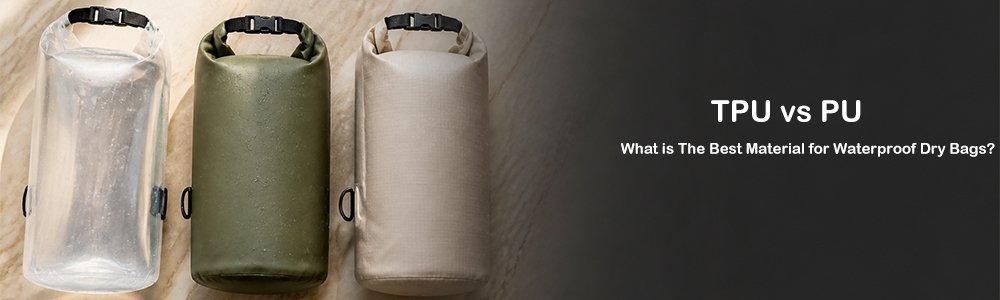
When souring custom waterproof dry bags, you might still be struggling to choose between TPU and PU materials.Like one of our clients in early June who commissioned us to customize OEM waterproof dry bags. The choice between TPU and PU directly impacts your product’s performance, lifespan, and profit margin.
After comprehensively considering the client’s target market and budget, we provided a solution of customizing TPU waterproof dry bags. Below, we will explain in detail the differences between TPU and PU waterproof dry bags.
TPU VS PU Waterproof Materials
The biggest difference between TPU and PU waterproof bags lies in the waterproof material.
What is a TPU Waterproof Coating?
TPU is an abbreviation for thermoplastic polyurethane. It is a pre-formed film that is directly laminated onto fabric under high temperature conditions to form a stable, durable, and waterproof layer. The typical structure is as follows:
- Surface Coating – Enhances abrasion resistance and UV protection.
- TPU Waterproof Membrane – Prevents moisture penetration.
- Base Fabric – Mostly nylon and polyester fabrics, high strength, and good tear resistance.
TPU’s water resistance can reach 10,000-20,000 mm, meaning TPU waterproof bags can keep the inside dry even in heavy rain, making them ideal for outdoor adventures and water sports.
Advantages:
- Elasticity: TPU is very flexible and maintains its elasticity for a long time.
- Durability: Not easily worn, long service life.
- Environmentally Friendly: Free of phthalates and chlorine, and recyclable.
Disadvantages:
- High Cost: The FOB surcharge of $1.50 to $4.50 per meter increases the procurement cost of custom waterproof bags.
- Insufficient Breathability: Despite its good sealing, it easily accumulates heat and moisture, potentially causing odors.
What is a PU Waterproof Coating?
PU is an abbreviation for polyurethane, a flexible plastic chemical coating applied directly to the surface of fabrics such as nylon or polyester through a baking process to enhance the fabric’s water resistance. The material structure of a PU waterproof bag is as follows:
- PU Waterproof Coating: Improves the fabric’s water resistance.
- Fabric Layer: Mostly 70-210D denier nylon.
The PU coating has a water resistance range of 5,000-10,000 mm, effectively preventing light rain and splashes. As a lightweight and affordable solution, it is currently the most commonly used waterproofing method in the bag industry.
Advantages:
- Softness: PU waterproof material has a soft touch, enhancing the carrying comfort of customized bags.
- Breathability: Some water vapor can pass through PU material, offering better breathability compared to TPU.
- High Cost-Effectiveness: The FOB surcharge is $0.50 to $2 per meter.
Disadvantages:
- Slightly Shorter Lifespan: Over time, the PU coating’s waterproof performance gradually decreases due to wear and tear.
- Environmental Impact: Derived from petroleum resources, it is not environmentally friendly.
Which Performs Better – TPU Or PU Custom Waterproof Bags?
TPU and PU waterproof bags differ in strength, weight, and waterproof rating.
Are Custom TPU Waterproof Dry Bags More Flexible Than PU?
TPU is closer to elastic rubber, meaning it retains its elasticity and flexibility even after repeated folding and rolling. We conducted field tests on TPU roll-top waterproof bags, and they withstood over 2000 folds without cracking.
PU is harder and thicker than TPU. While it allows the empty waterproof bag to maintain its shape, prolonged use and repeated folding may cause permanent creases.
Which is Lighter? – TPU Or PU Waterproof Dry Bags
According to Kewei factory measurements, TPU laminated nylon weighs approximately 280-420 grams per square meter, while PU coated nylon weighs approximately 150-300 grams per square meter.
For example, making a medium-sized hiking backpack requires approximately 1.2-1.5 meters of fabric in length and 150cm in width. Using the same webbing, hardware, and buckles, TPU waterproof bags are typically 250 to 270 grams heavier than PU waterproof bags.
Although the weight difference is less than the weight of a bottle of water, it makes a world of difference for long-distance hiking and travel. If your brand prioritizes lightweight outdoor backpacks, PU material is a better choice.
Do TPU or PU waterproof Dry Bags Handle Cold and Heat Better?
The performance of both TPU and PU waterproof bags is affected by ambient temperature, but to different degrees.
TPU has a wide safe temperature range, from -40°C to 90°C. When exploring snow-capped mountains or polar regions, TPU waterproof dry bags can still maintain a certain degree of flexibility and elasticity. For desert or tropical expeditions or summer storage in vehicles, TPU’s heat resistance ensures the dry bag structure does not deform and will not age rapidly due to UV exposure, preventing peeling.
PU waterproof dry bags, on the other hand, become very stiff in environments below -20°C, and the coating may even crack and peel off. At high temperatures, the coating of PU waterproof bags may decompose, bubble, and peel off.
Performance of TPU and PU waterproof bags at different temperatures:
| Temperature (°C) | TPU Waterproof Bag | PU Waterproof Bag |
| -20 | Performs normally | Extremely stiff |
| 0 | Slightly firm | Stiff |
| 25 | Soft and elastic | Moderately firm |
| 40 | Stable | Soft, but may develop odor |
Which Dry Bags Are More Durable – TPU or PU?
Over time, both PU and TPU coatings will reach their maximum lifespan, and their waterproof performance will fail. However, the time it takes for the coating to peel and fail differs. PU waterproof dry bags have a shorter lifespan, while TPU waterproof drybags have a longer lifespan. Based on the ISO 1419 accelerated aging benchmark and published ACT/Gantrade field test data, we have estimated the following table:
| Material | Visible Peeling / Tackiness | Complete Failure | Primary Causes |
| TPU | 7–10 years | 10–12 years | Heat, humidity, abrasion |
| PU | 2–4 years | 3–5 years | High heat and humidity |
PU coatings are more susceptible to the effects of high temperature and humidity environments. Therefore, when choosing waterproof bags for sea freight and warehouse storage, pay attention to indoor temperature and humidity.
Are TPU Dry Bags More expensive Than PU Dry Bags?
For waterproof bags of the same style, choosing between TPU and PU coatings will affect the actual cost of customization. Below is the cost per meter of fabric for different coatings in the bag industry:
| Coating Type | Additional Cost Per Meter | Common Applications |
| TPU single-side lamination | $0.50-$1.50 | Standard waterproof bags |
| TPU double-side lamination | $1.20-$2.00 | Cycling bags, underwater gear |
| Single-pass PU | $1.50-$3.00 | Everyday commuter waterproof bags |
| Double-pass PU | $3.00-$4.50 | Heavy-duty outdoor waterproof bags |
The above data is from Kewei factory purchasing data. Specific prices vary depending on the factory, order quantity, and film specifications.
Compared to single-pass PU waterproof dry bags, a custom TPU waterproof dry bag will cost typically add $1 to $3 to the per-unit FOB Price(Free On Board). If you only focus on the upfront cost when customizing waterproof dry bags, ignoring the warranty and return processing costs that may result from hydrolysis failure, the later losses could be much greater.
If your brand’s target market is humid regions such as Southeast Asia, Kewei recommends prioritizing TPU or polyether-TPU waterproof dry bags.
How Do Brands Choose Between TPU or PU Dry Bags?
Choosing between TPU and PU waterproof dry bags depends on the usage scenario, durability requirements, and consumer preferences. Outdoor gear brands can prioritize based on the following points. Below is Kewei’s custom dry bag decision reference matrix:
| Decision Factor | TPU Waterproof Bag | PU Waterproof Bag |
| Use Case | High-intensity outdoor activities: mountaineering, hiking, cycling, whitewater, sailing, long-haul travel | Low-to-medium intensity activities: commuting, urban use, gym, light travel, everyday storage |
| Waterproofing Needs | Extended exposure to rain, mud, or wet environments | Light rain, splashing, or brief moisture exposure |
| Durability Needs | More abrasion-resistant, tear-resistant, and cold-weather capable; built for heavy use and tough conditions | Moderate durability; better suited for lightweight, lifestyle-oriented use |
| Feel & Aesthetics | Softer hand feel; technical and outdoor aesthetic | Holds shape better; suits urban and casual styles |
| Lifespan | 7–10 years with normal use | 3–5 years |
| Budget | Higher cost; appropriate for mid-to-high-end or professional outdoor lines | Cost-controlled; well-suited for entry-level or promotional products |
| Target Consumer | Performance-driven buyers who prioritize waterproofing and long-term durability | Value-conscious buyers looking for lightweight, practical everyday options |
| Recommended Products | Premium hiking packs, waterproof dry bags, cycling bags, outdoor travel bags, sailing dry bags | Commuter backpacks, gym bags, urban crossbody bags, light travel bags, entry-level waterproof bags |
How Do Brands Ensure Your Custom Waterproof Dry Bag Performs
Confirming The Dry Bag Waterproof Rating
When Kewei receives an order inquiry for OEM waterproof bag projects, we first confirm the customer’s target waterproof rating.It is because it relates to the choice of materials and the strength of the waterproof performance.
| Waterproof Rating | Hydrostatic Head | Recommended Coating | Test Method |
| IPX3–IPX4 | <1,500mm | Single-pass PU | ISO 811 |
| IPX4–IPX5 | 1,500–3,000mm | Single-pass PU | ISO 811 |
| IPX5–IPX6 | 3,000–5,000mm | Double-pass PU | ISO 811 |
| IPX6 | 5,000–10,000mm | Double-pass PU | ISO 811 |
| IPX7 | 10,000–15,000mm | TPU single-side lamination | ISO 811 |
| IPX8 | 15,000–20,000mm | TPU double-side lamination | ISO 811 |
Manufacturing Processing of Dry Bag
Even with the best waterproof fabric, the performance of a waterproof dry bag can easily fail if waterproof zippers, sealed seams, and proper treatment of the baffles and bottom plate are not used. Discuss the following processes with your custom waterproof dry bag factory:
- Waterproof Zippers – Ordinary zippers can leak under pressure or heavy rain. Using YKK waterproof zippers improves waterproof performance.
- Seam Seams – Use techniques such as pressure bonding, heat pressing, or high-frequency welding to treat the seams of waterproof bags, reducing the risk of pinhole leakage.
- Reinforced Base – Exposed bases are prone to water seepage on damp surfaces. We recommend using thickened waterproof fabrics such as TPU/PVC for the base of waterproof bags, which effectively solves this problem.
- Roll-Top Design – Roll-top waterproof bags have excellent waterproof capabilities, but ensure the roll-top is rolled at least three times.
Professional Testing
In addition to using high-quality materials, you can explicitly include third-party laboratory testing in your purchase contract, such as SGS, Intertek, or Bureau Veritas. Note that these tests require additional payment. However, some tests are worth trying to ensure performance.
The following are the testing methods and requirements for the performance of TPU or PU waterproof bags:
| Test | What It Verifies | Applicable Standard | Recommended Benchmark |
| Hydrostatic Head | Fabric waterproofing capability | ISO 811:2018 / AATCC ISO 127 | 1,500–3,000mm for everyday use; higher for professional-grade bags |
| Hydrolysis Aging | How long PU/TPU holds up in sustained heat and humidity before degrading | ISO 1419 Method C / ASTM D3690 | ≥5 weeks for PU; ≥10 weeks recommended for premium TPU |
| Coating Adhesion | Bond strength between TPU film or coating and base fabric | ASTM D903 | ≥6 lbs/inch for bag-grade TPU to prevent delamination or bubbling |
| Abrasion Resistance | Simulates friction from outdoor surfaces, rocks, bike frames, and daily wear | ISO 12947 / Martindale | PU fabric ≥15,000 cycles; TPU fabric ≥30,000 cycles |
| UV Resistance | Whether sun exposure causes fading, brittleness, or performance loss | ASTM G155 | UV-resistant TPU recommended for outdoor bags |
| Flex Durability | Whether repeated folding, rolling, and compression causes cracking | ASTM D2097 | ≥15,000 flex cycles without cracking, delamination, or visible damage |
| Seam Seal Integrity | Whether heat-pressed, welded, or taped seams hold under water pressure | Combined with finished product rain/submersion testing | No leakage at seams; heat press or high-frequency welding recommended for premium bags |
| Zipper & Closure Waterproofing | Water resistance at zippers, roll-tops, buckles, and openings | Referenced against IPX finished product testing | Everyday bags: splash-proof or rain-resistant; dry bags: full roll-top submersion seal |
How Chinese Bag Manufacturers Produce TPU vs PU Dry Bags Differently?
Many people may assume that the production processes for these two types of waterproof bags are similar, but in reality, their production plans, manufacturing processes, minimum order quantities, and delivery times differ.
- Blade Replacement Frequency – Cutting TPU material requires frequent blade replacements to prevent rough edges. Blades for cutting PU-coated fabrics require less frequent replacement than those for TPU waterproof bags.
- Sewing Process – Sewing workshops are hot, and the TPU film can easily heat up and stick to the sewing needle. We use Teflon-coated needles and slow sewing techniques to avoid needle marks and missed stitches. PU-coated fabrics can be sewn using standard stitching.
- Seam Treatment – TPU waterproof bags often use heat-fusion welding, requiring skilled workers to operate the welding equipment. PU-coated waterproof bags use tape to reinforce the seams.
- Minimum Order Quantity – The more complex the manufacturing process, the higher the minimum order quantity. Custom-made TPU fabric requires at least 1000-3000 meters, while PU-coated fabric only requires 300-500 meters. This also means that the minimum order quantity for custom TPU waterproof bags is higher than that for PU waterproof bags, depending on the supplier.
- Lead Time – The fabric sourcing and production cycle for TPU waterproof bags is longer, so the order delivery time may be 2-3 weeks longer than that for PU coated waterproof bags.
Kewei collaborates with global outdoor brands, retailers, and e-commerce companies, and has developed over 1,100 custom TPU and PU waterproof bag projects, including:
- Roll-top waterproof bags
- waterproof travel bags
- kayak waterproof bags
- Lightweight waterproof backpacks
We not only offer a variety of waterproof materials such as polyester-TPU, polyether-TPU, PU, and PVC, but you can also enjoy OEM services including custom structure development, custom colors, logos, and packaging. Want to discuss your custom TPU or PU dry bag project in detail? Please contact us, and we will recommend suitable solutions and explain why.
FAQ
What’s the difference between water-repellent, water-resistant, and waterproof?
These three terms indicate different levels of waterproofing effectiveness:
- Water-repellent: Water droplets can condense on the surface of the waterproof fabric, but the fabric will eventually become soaked.
- Water-resistant: Can withstand light rain for a short time without getting wet.
- Waterproof: Can withstand heavy rain and effectively block water.
Are TPU waterproof bags better than PU ones?
Generally, yes. TPU waterproof bags have better waterproofing, abrasion resistance, and temperature adaptability than PU waterproof bags, and they also last longer.
Which waterproof bag types are best for outdoor and water sports?
It’s better to choose a fully waterproof roll-top TPU waterproof bag. Additionally, seams and zippers should be waterproofed.
How to distinguish between TPU and PU waterproof dry bags?
- TPU waterproof bags are soft to the touch and elastic when stretched, while PU waterproof bags are stiffer and less elastic.
- TPU waterproof bags typically use heat fusion welding for their seams, making the seams invisible; PU waterproof bags usually have seams that are sewn together and then taped.
- TPU waterproof bags have almost no odor, while low-quality PU bags will have an unpleasant smell.
- The most direct way to tell is to check the product specification sheet, which will list the materials used.