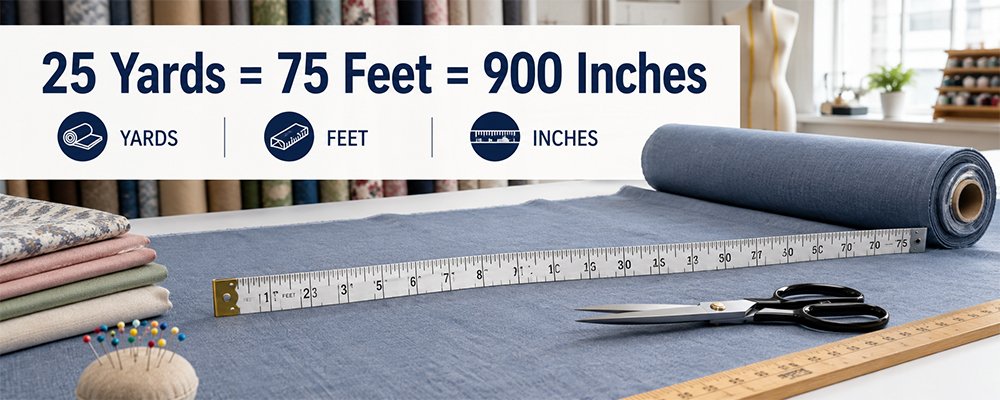
25 yards to feet is one of the most common fabric conversions, and the answer is simple: 25 yards of fabric equals 75 feet, or 900 inches. Whether you’re in the backpacking, apparel, or home décor industry, you’ll likely need to know how to convert fabric yards to feet or inches. The blog helps you order the right amount of fabric, reduce waste, and control costs.
| Yards | Feet | Inches |
|---|---|---|
| 25 yd | 75 ft | 900 in |
Key Takeaways
- 25 yards equals 75 feet or 900 inches.
- Converting yards to feet and inches is very simple: multiply the yardage by 3 to get the feet, and by 36 to get the inches.
- Order fabric that is wider than possible. This makes production much easier; you only need to cut it, not hemming.
- To get a more intuitive idea of the length of 25 yards of fabric, it’s simple. It’s about the length of two standard school buses lined up end to end, or about half the length of an Olympic swimming pool.
- Before cutting or ordering, remember to carefully check the unit conversion to avoid size errors and delays.
How Big is 25 Yards of Fabric?
To know how much 25 yards is, you first need to know how big 1 yard is. Since 1959, the relationship between yards and feet has been standardized internationally, meaning 1 yard equals exactly 3 feet, or 36 inches. Therefore, knowing exactly how big 25 yards is is very simple; just convert:
- Yards → Feet: 25 x 3 = 75 feet
- Yards → Inches: 25 x 36 = 900 inches
Therefore, 25 yards of fabric equals 75 feet, or 900 inches, approximately 22.86 meters.
In our experience, 25 yards of fabric are usually used for sampling when producing backpacks. This is because 25 yards of fabric is generally insufficient for bulk orders, especially for complex backpack designs involving multiple pockets, linings, and panels, such as hiking backpacks and mountaineering backpacks.
As a backpack manufacturer, we carefully calculate the fabric length when ordering fabric in bulk, and if necessary, we use a measuring instrument called a “Trumeter” for precise measurement. In addition, confirming the fabric width, weight, elasticity, shrinkage rate, and composition is also one of our verification items.
25 yards to Feet or Inches
We have compiled some commonly used sizes and converted them to their corresponding feet and inches. You can refer to this table when purchasing and cutting to save time.
| Yards | Feet | Inches |
|---|---|---|
| 1/8 yd | 0.375 ft | 4.5 in |
| 1/4 yd | 0.75 ft | 9 in |
| 1/3 yd | 1 ft | 12 in |
| 1/2 yd | 1.5 ft | 18 in |
| 3/4 yd | 2.25 ft | 27 in |
| 1 yd | 3 ft | 36 in |
| 2 yd | 6 ft | 72 in |
| 3 yd | 9 ft | 108 in |
| 5 yd | 15 ft | 180 in |
| 10 yd | 30 ft | 360 in |
| 15 yd | 45 ft | 540 in |
| 20 yd | 60 ft | 720 in |
| 25 yd | 75 ft | 900 in |
| 30 yd | 90 ft | 1,080 in |
| 50 yd | 150 ft | 1,800 in |
| 100 yd | 300 ft | 3,600 in |
Common Mistakes When Converting Yards to Feet
To ensure data accuracy, the following errors should be avoided during conversion.
- Incorrect conversion direction. To convert yards to feet, multiply by 3; to convert feet to yards, divide by 3. The order of operations is easily reversed during rapid calculations.
- Premature rounding. When calculating area or cost per square foot, the calculation process should always retain decimal places, with rounding only performed in the final step to reduce errors.
- Confusing yards with meters. Numerically, one yard (0.9144 meters) and one meter are close, but should not be treated as equivalent, especially when working with international clients where data accuracy is crucial.
- Ignoring fabric width. A narrow fabric width of 25 yards (36 inches) covers a significantly smaller area than a fabric width of 25 yards (60 inches). When using sheet material, it’s best to calculate the total area covered.
Understanding Fabric Width
Fabric width is an important measurement of fabric. Common fabric widths range from 42 inches to 62 inches, such as 44 inches, 45 inches, 54 inches, and 60 inches. Wider fabrics may require fewer yards, and vice versa.
The table below shows common fabric widths and the required amount of fabric (in yards).
| Fabric Width | Yards Required |
|---|---|
| 32 in | 1⅞ |
| 35 in | 1¾ |
| 36 in | 1⅔ – 1¾ |
| 39 in | 1½ |
| 41 in | 1½ |
| 42 in | 1 7/16 |
| 44 in | 1⅜ |
| 45 in | 1⅓ – 1⅜ |
| 54 in | 1⅛ |
| 60 in | 1 |
| 72 in | ⅚ |
Fabric width has a significant impact on the area covered by the fabric. For the same yardage, a wider fabric allows for a larger area to be cut, resulting in fewer seams. If you want to know the coverage area and uses of different widths for 25 yards of fabric, please refer to the table below.
| Fabric Width | Total Area (sq ft) | Typical Use |
|---|---|---|
| 42 in | ~262.5 | General-purpose standard width |
| 44 in | ~275 | Chiffon; apparel |
| 45 in | ~281.25 | Cotton; tote bags |
| 54 in | ~337 | Most common in the US; home décor |
| 60 in | ~375 | Large-scale projects |
| 72 in | ~450 | Industrial and specialty applications |

How to Calculate Fabric Area
Multiply the length of the fabric by its width to get its area. Before calculating the area, first learn how to measure the fabric’s yardage and width.
Measuring Fabric Yardage
- The yardage is the length of the fabric. You can accurately measure the length by following these steps:
Lay the fabric flat on a smooth surface, such as a floor or a large table. - Measure the length along the edge of the fabric. Note that you should not measure cut edges or beveled edges, as the data may be inaccurate.
Measuring Fabric Width
Lay the fabric flat first, then measure the distance from the selvage horizontally. This measurement is the fabric width. However, note that the selvage is usually not used in practice; it’s best to mark the available width separately.
Area Calculation — 25 yards example
- 25 yards of fabric has a total length of 900 inches.
- Choose an appropriate fabric width, such as 44, 54, or 60 inches.
- Multiply the length by the width. For example, 900 inches multiplied by 60 inches equals 54,000 square inches.
- Divide the total area by 1296 to convert it to square feet. To get the value in square centimeters, simply multiply the total area by 6.4516.
- 54,000 ÷ 1296 = 31.25 square feet
- 54,000 x 6.4516 = 348,386.4 square centimeters = 34.84 square meters
Visualizing 25 yards
If you still don’t have a clear idea of the exact length of 25 yards of fabric, you can compare it to everyday items. For example:
- 2 school buses. A standard school bus is approximately 35 to 40 feet long.
- 25 standard interior doors. American interior doors are typically 6.67 feet high.
- 25 large bath towels. One large bath towel is nearly one yard in area; 25 towels laid end to end and spread out would be ideal.
If you want to know how much fabric is needed to make a bag, please continue to follow Kewei’s blog. We will discuss this topic in detail in our next post. Of course, you can also send us a direct inquiry, and we will answer you as soon as possible.
FAQ
What tools can accurately measure fabric?
A measuring tape and a tailor’s square are both acceptable. When measuring, the edges of the fabric must be kept straight.
How do backpack factories measure fabric width?
Backpack factories typically use fabric inspection machines to confirm the actual width of the fabric and the effective width that can be cut.
What can you make with 25 yards of fabric?
25 yards of fabric can make approximately 10+ summer T-shirts, curtains for 3-4 large windows, 12-15 standard backpacks (without lining), 30-40 shopping bags, etc. But the exact number will depend on the width of the fabric.
Is 25 meters the same as 25 yards?
No. 1 yard = 0.9144 meters, 25 yards equals 22.86 meters, which is smaller than 25 meters.