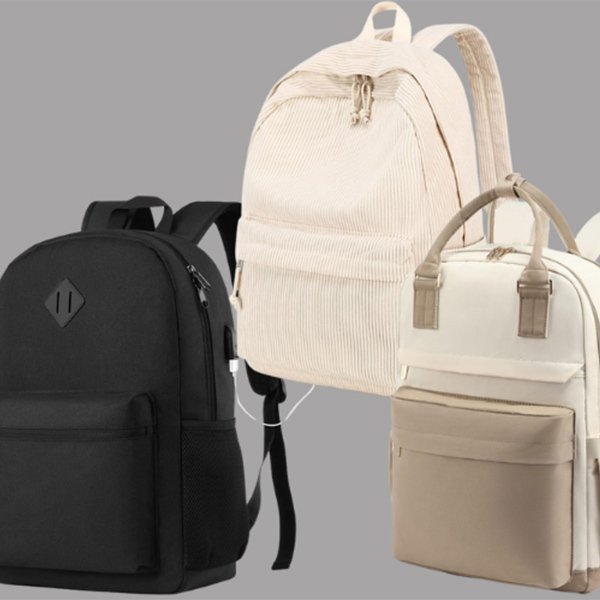
Fitness is becoming more and more popular. As essential equipment for fitness activities, gym bags can efficiently organize training shoes, water bottles, towels, and workout clothes, making fitness easier and more effortless. Therefore, we can find more and more fitness enthusiasts wanting to equip themselves with a professional gym bag. They also increasingly expect sports brands and retailers to offer gym bags in various sizes to meet different training styles and needs.
Kewei manufactures and customizes gym bags for global brands and retailers, so we understand every aspect of gym bags. This gym bag size guide will take you through the standard gym bag capacity, the optimal size for different sports, and typical differences in men’s and women’s sizes. Whether you are a consumer looking for your next gym bag or a B2B buyer planning a custom order, you can find everything you need here.
Quick Summary:
- Gym bags generally range from 25 to 50 liters, with sizes falling into small, medium, large, and extra-large categories.
- Small bags work well for light training; medium bags suit most everyday gym-goers; large bags are best for athletes, swimmers, or those combining gym with travel.
- Gym bags for men typically fall in the 35–50L range; women’s in the 25–40L range.
- Two bags with the same liter rating can feel very different in practice depending on their shape and construction.
- Choosing a versatile gym bag means it can take you from daily training sessions to weekend travel without skipping a beat.
How to Measure a Gym Bag
Before comparing sizes, understanding how gym bag dimensions are actually measured is very helpful. Knowing it lets individual buyers assess fit more accurately — and gives brands and retailers the technical vocabulary they need when working with manufacturers.
Measuring a Rectangular Gym Bag
Most gym bags have a regular rectangular shape, so measuring their size is simple. You can measure both the external and internal dimensions depending on your needs.
- Step 1 — Measure the length. Lay the bag flat on a table. Straighten out any curved or slumped sides, then measure horizontally from one end of the longest side to the other.
- Step 2 — Measure the height. Stand the bag upright. Run a soft tape measure from the base to the highest point of the bag, not including handles or shoulder straps.
- Step 3 — Measure the depth. Measure the shortest side of the bag horizontally to get the depth.
Once you have all three dimensions, multiply them together and divide by 1,000. The result is the bag’s volume in liters. Knowing the bag’s dimensions is crucial to determining whether it will fit in a gym locker, airplane overhead bin, or car trunk.
Measuring Irregularly Shaped Gym Bags
Some gym bags are designed with rounded, oval, or otherwise irregular shapes. For these, a fill test is more reliable than a dimensional calculation.
- Fill standard 1-liter water bottles, cap them tightly.
- Pack them into the bag one by one until the bag is full.
- Count the bottles — that total is the bag’s real-world usable capacity in liters.
Most manufacturers include both dimensions and capacity in their product specifications, which is particularly helpful when placing wholesale or custom orders.
Standard Gym Bag Sizes
The frequency of your workout will influence the gym bag dimensions. Someone who hits the gym two or three times a week needs space for the basics — water, a towel, and a change of clothes. A fitness instructor or someone training five or six days a week will need a larger bag that can handle shoes, full training gear, snacks, and recovery supplements, ideally with dedicated compartments to keep everything organized.
The table below covers the most common gym bag size categories, along with typical dimensions, recommended items, and the scenarios each size suits best.
Gym Bag Size Chart: Capacity, Dimensions, and Use Cases
| Category | Capacity | Dimensions (cm) | What Fits | Best For |
| Small | 20–30L | 40–45 × 22 × 20 | Gym clothes, water bottle, towel, phone, keys | Light training, yoga, cycling |
| Medium | 30–40L | 45–50 × 25 × 25 | Gym clothes, towel, shoes, water bottle, phone, keys | Daily gym use |
| Large | 40–55L | 50–55 × 28 × 28 | Clothes, shoes, towel, water bottle, snacks, accessories | Weightlifting, team sports |
| Extra Large | 55L+ | 55–65 × 30 × 30 | Full kit for 2–3 activities: clothes, shoes, towel, water, snacks, equipment | Team travel or multi-sport use |
Converting to inches: Divide centimeters by 2.54. A 50 cm bag is approximately 19.7 inches long.
Gym Bag Sizes by Sport
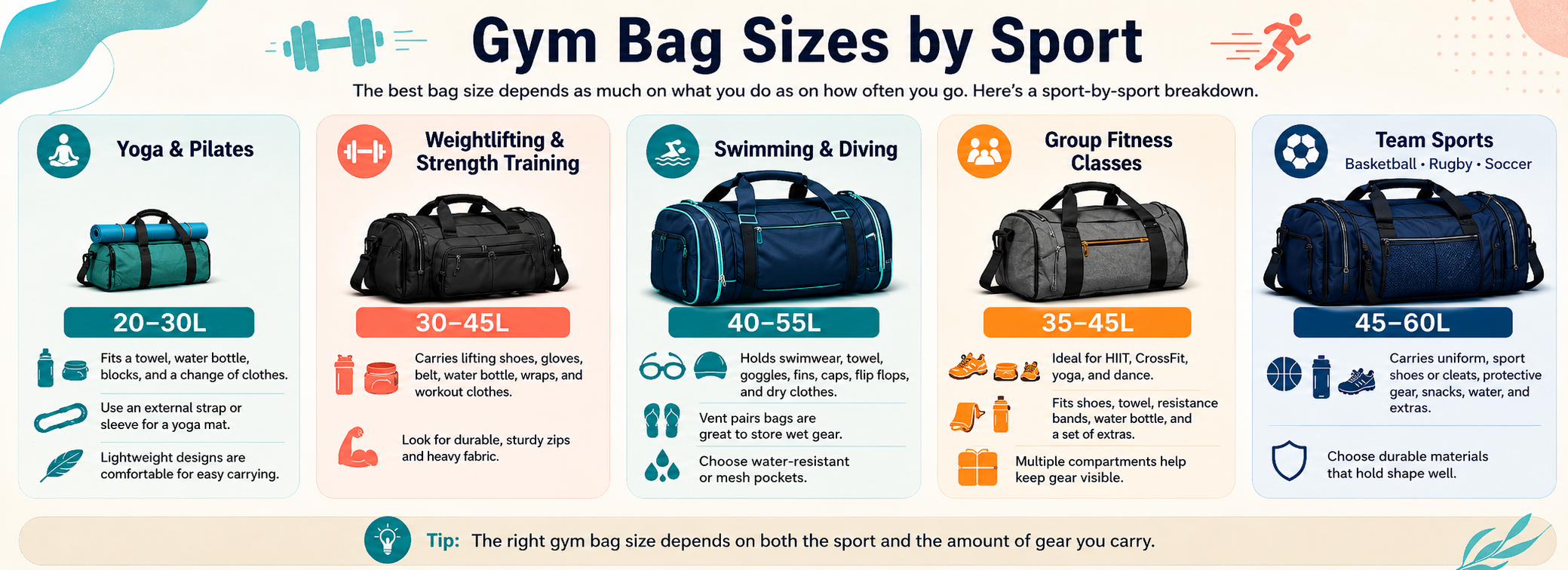
The best bag size depends as much on what you do as on how often you go. Here’s a sport-by-sport breakdown.
Yoga and Pilates
A typical yoga or Pilates session calls for a mat, blocks, a towel, a water bottle, and a change of clothes. In most cases, 20–30L bag is plenty. Look for one with an external strap or sleeve to hold the yoga mat, since this capacity can’t fit a rolled mat inside. Bags with long shoulder straps tend to be the most comfortable carry for this type of session.
Weightlifting and Strength Training
Strength training athletes tend to carry a lot: lifting shoes, gloves, a belt, a chalk bag, a protein shaker, and workout clothes. Fitting everything easily requires at least a 30–45L bag.
Swimming and Diving
Swimming involves more gear than almost any other gym activity — swimsuits or wetsuits, goggles, a swim cap, a towel, a kickboard, flip-flops, and dry clothes for after. Wet gear also takes up considerably more space than dry gear.
A 40–55L bag is the right choice, and ideally one with a wet/dry separation compartment or external mesh pockets. This keeps soaked gear away from dry clothing and helps prevent mold and odor buildup.
Group Fitness Classes
Group fitness classes — HIIT, CrossFit, and spin — typically call for shoes, a towel, resistance bands, a water bottle, and a change of clothes. A 35–45L bag is enough. Look for a design with multiple compartments so you can locate items quickly between exercises.
Team Sports (Basketball, Rugby, Soccer)
Team athletes usually carry a uniform, sport-specific shoes, shin guards or pads, water, and snacks. A 45–60L bag is the practical choice, especially one made from a durable material that can handle cleats or spiked shoes without losing its shape.
Men’s vs. Women’s Gym Bag Sizes
Men’s gym bags typically run larger — usually 35–50 liters — and are usually structured travel bags or backpacks. The design and structure are relatively simple, with a separate shoe compartment and very few external pockets.
Women’s gym bags generally sit in the 25–40 liter range and lean toward handbag, crossbody, or convertible styles. These bags usually have more internal organization: additional pockets, a dedicated shoe sleeve, and a separate wet bag.
That said, not all men’s gym bags need to be larger than women’s. Capacity is an option; women can certainly choose gym bags of 50 liters or more to hold more of their gym gear. Men can also choose 25L gym bags for easier outings.
Does Shape Affect How Much a Gym Bag Actually Holds?
Two bags rated at the same liter capacity can feel different in actual use, because of their shape and design. Here’s a quick comparison:
| Bag Type | Usable Space at Same Volume | Pros | Cons |
| Duffel / Travel Bag | High — wide opening, flexible structure | Easy to pack and unpack | Less organized |
| Backpack | Medium — compartmentalized layout | Hands-free, comfortable to carry | Hard to reach items at the bottom |
| Tote Bag | Low to medium — open top | Lightweight and stylish | No structure; items shift around |
| Drawstring Bag | Low — narrow round opening | Very lightweight | Limited real-world capacity |
Overall, travel bags have larger openings and more flexible structures, offering more usable space for the same capacity. This is why many fitness enthusiasts prefer travel gym bags.
What Size Gym Bag Do I Need?
There’s no universal answer — it depends on what you carry. Use the table below as a starting point:
| What You Typically Bring | Recommended Size |
| Water bottle, phone, keys, light jacket | 15–20L |
| Above + athletic shoes + a change of clothes | 20–30L |
| Above + towel + toiletries | 30–40L |
| Above + extra shoes + supplements + snacks | 40–50L |
| Full kit for swimming, team sports, or travel | 50L+ |
At Kewei, gym bag orders account for 25% of total business. Daisy, the business manager in charge of the gym bag project, notes that her clients really like the 25–30L size because it is large enough to meet daily workout needs and can also be used as a commuter bag, making it a very practical capacity option.
How to Find Your Ideal Gym Bag Size in 3 Steps
If you’re still unsure, work through these three questions:
Step 1 — Define your scenario
- What activities do you typically do? Different sports have different gear requirements — refer to the “Gym Bag Sizes for Different Sports” section in this blog post.
- How often do you train? The more frequently you go, the more practical a larger bag becomes.
- What do you always bring? Take stock of the bulkiest items in particular — shoes and towels are the biggest space consumers.
Step 2 — Match your gear to a size
- 0–2 bulky items → 20–30L
- 3–4 bulky items → 30–45L
- 5 or more bulky items, or wet gear → 45L+
Step 3 — Think about comfort and how you carry it
Comfort is crucial for a gym bag; it can determine how often you use it. Look for padded shoulder straps or handles, especially if you’re packing heavy. If you commute by bike or public transit, a backpack or crossbody style keeps your hands free and makes the journey easier. If you drive to the gym, a duffel is usually the most convenient option.
The bottom line: 25–40 liters is a suitable choice— large enough for a complete kit, compact enough for a daily commute. Within that, prioritize a bag that fits your style and the way you actually get to the gym.
If you’re looking to customize a gym bag for your brand — with your logo, a separate shoe compartment, multiple pockets, and a side water bottle sleeve — contact the Kewei team. We offer OEM and ODM production with flexible MOQ to suit brands at every stage.
FAQ
How do I organize a gym bag?
Make a list before packing. This will make it easier to find the items you need and keep the bag tidy. Following the principle of placing frequently used equipment on the top shelf allows for quick packing:
- Clean clothes should be placed in the main compartment;
- Wet towels and sweaty clothes should be placed in the waterproof compartment, or put in a separate bag before placing them in the gym bag.
- Keys, earphones, mobile phones, and membership cards should be placed in the compartment for security and easy access.
- Shoes should be placed in a separate shoe compartment, or put in a shoe bag before placing them in the gym bag.
- Regularly clean your gym bag to reduce odors and bacterial growth.
What size gym bag fits in a standard locker?
Most standard lockers are suitable for storing small or medium-sized gym bags, and soft-sided bags with a capacity of less than 40L are generally versatile. Please confirm the dimensions of the gym lockers before purchasing.
Is a 40-liter gym bag a good choice?
Yes. 40 liters is a very practical capacity choice. It can hold shoes, a change of clothes, a towel, a water bottle, toiletries, and small accessories, and its moderate size makes it convenient for daily commutes.
Should I get a duffel, backpack, crossbody, or tote for the gym?
It depends on your habits and how you get there. Travel bags are spacious and durable. Backpacks are more comfortable and free up your hands. Crossbody bags make it easier to access items. Tote bags are stylish and suitable for light exercise.