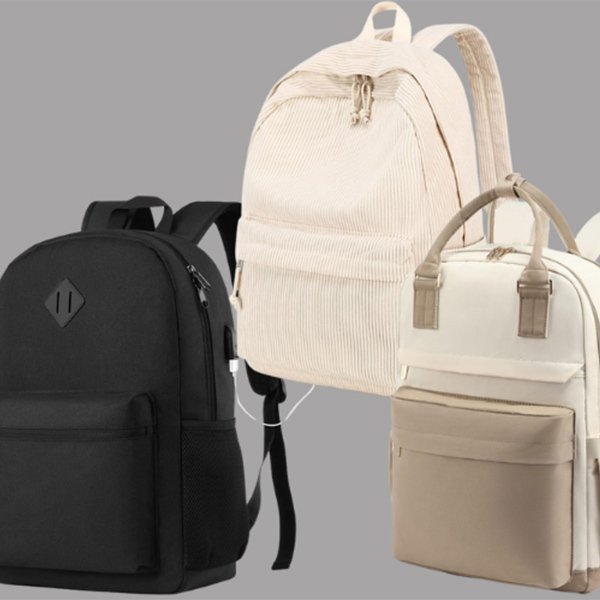
Backpack shoulder straps are one of the most important components in backpack design, as they directly affect carrying comfort and support. Currently, J-shaped and S-shaped shoulder straps are two of the most popular options for custom backpacks. Each design has its own advantages and is suitable for different body types and user preferences.
Today, we will analyze the characteristics of these two shoulder strap designs to help you decide which option is the best choice for your custom backpack.
What Is a J-Shaped Backpack Shoulder Strap?
In terms of appearance, a J-shaped shoulder strap has only one main curve, resembling the letter “J”, with a relatively straight and vertical overall shape.
J-shaped shoulder straps provide a simple and clean design while helping distribute the backpack’s weight across the shoulders and chest area. Due to their lower customization cost and straightforward manufacturing process, they have become the classic design choice for many backpacks.
However, as backpacks are now used in a wider range of scenarios and carried more frequently, users have gradually reported some limitations of J-shaped shoulder straps.
They are generally more suitable for people with narrower or straighter shoulders. For users with sloped shoulders or a rounder upper body shape, J-shaped straps may press against the collarbone or slide outward, preventing the backpack from fitting closely against the body.
It may increases pressure on the trapezius muscles and cause shoulder and neck fatigue, especially for outdoor hikers who need to carry heavier loads for extended periods.

What Is an S-Shaped Backpack Shoulder Strap?
An S-shaped shoulder strap features a double-curve structure, similar to the letter “S”.
The upper curve, from the collarbone to the chest area, extends outward, while the lower curve, toward the waist and back area, curves inward.
To overcome the limitations of traditional J-shaped shoulder straps, backpack designers developed S-shaped shoulder straps based on ergonomic principles.
The curved structure follows the natural shape of the shoulders and chest, allowing pressure to be distributed more evenly across the top of the shoulders, chest, and back, reducing pressure points.
In addition, the curved profile helps keep the shoulder straps securely positioned, preventing them from sliding off the shoulders even when walking on uneven terrain.
Therefore, S-shaped shoulder straps are more suitable for people with broader shoulders, sloped shoulders, or a fuller chest shape.
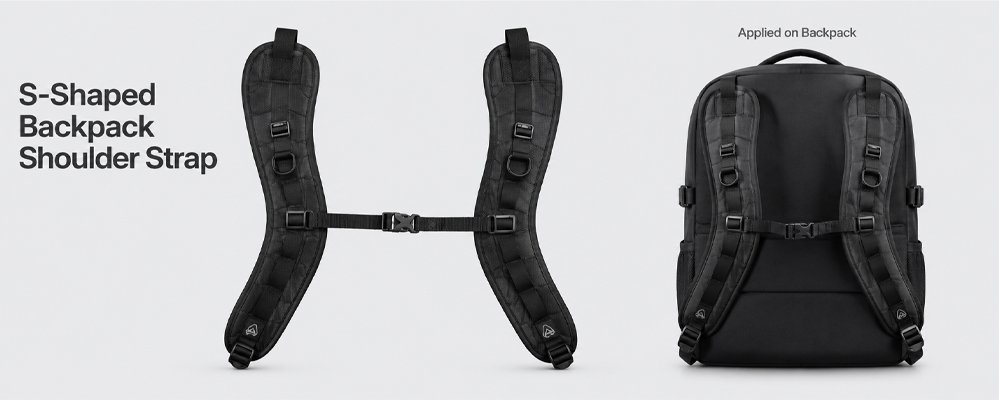
Difference Between J-Shaped and S-Shaped Shoulder Straps
| Comparison | J-Shaped Backpack Shoulder Strap | S-Shaped Backpack Shoulder Strap |
| Shape Design | Features a relatively straight structure with one curve, resembling the letter “J”. | Features a double-curve ergonomic design, resembling the letter “S”. |
| Fit & Body Adaptation | Users with narrower shoulders may experience the straps sliding outward. | Designed based on body ergonomics, providing a closer fit and reducing strap movement. |
| Comfort Level | Simple structure with greater freedom of movement, suitable for short-term carrying or lighter loads. | Distributes weight more evenly, reduces shoulder and neck fatigue, and is better for long-term carrying. |
| Suitable Body Types | Suitable for users with balanced body proportions and straighter shoulders. Offers broad compatibility. | More suitable for narrow shoulders, female users, and people who need a higher level of body fit and support. |
| Common Backpack Types | Laptop backpacks, business backpacks, commuter backpacks, school backpacks, and everyday casual backpacks. | Hiking backpacks, travel backpacks, camera backpacks, and large-capacity outdoor backpacks. |
Real Factory Test: J-Shaped vs S-Shaped Backpack Shoulder Straps
We conducted a real carrying test in our factory using two backpacks with different shoulder strap designs.
To ensure accurate comparison, both backpacks had the same design and capacity (25L). The only difference was the shoulder strap structure: one used J-shaped shoulder straps, while the other used S-shaped shoulder straps.
When both backpacks were fully loaded and reached the same weight of 13 kg , the backpack with S-shaped shoulder straps provided a noticeably more comfortable carrying experience.
With the J-shaped shoulder straps, the inner edge of the strap pressed against the neck area. The lower section near the collarbone tended to roll outward, causing the outer part of the strap to lose contact with the chest.
As a result, pressure was concentrated around the shoulders and trapezius muscles, creating noticeable soreness after carrying.
However, with the S-shaped shoulder straps, the upper curve avoided pressure around the neck, while the lower curve extended outward to follow the rib cage.
The straps stayed flatter against the collarbone area, allowing the weight to be distributed more evenly.
For testers with a flatter chest and straighter shoulders, the difference between the two designs was much less noticeable.
Should You Choose J-Shaped or S-Shaped Backpack Shoulder Straps?
Consider Body Shape
Users with balanced body proportions, wider shoulders, and straighter shoulder lines are generally more suitable for J-shaped shoulder straps.
Users with narrower, sloped shoulders or a fuller upper body shape will usually benefit more from S-shaped shoulder straps, as they provide a more secure and comfortable fit.
Consider Load Capacity
For small backpacks, such as commuter backpacks, laptop backpacks, and school backpacks under 15L, the storage capacity and carrying weight are limited.
In these cases, J-shaped shoulder straps are usually sufficient and help maintain a cleaner, simpler backpack appearance.
For larger backpacks, especially hiking backpacks, multi-day trekking backpacks, and tactical backpacks, which often carry more than 15 lbs of gear, S-shaped shoulder straps are a better choice.
When combined with an internal frame, hip belt, or additional support system, they can provide even better stability and carrying comfort.
Consider Cost
In OEM/ODM backpack manufacturing, J-shaped shoulder straps have simpler cutting and construction processes, resulting in higher production efficiency and lower costs.
S-shaped shoulder straps require more complex pattern development, higher material precision, and slower manual sewing processes, making them a higher-cost option.
Please note that regardless of which shoulder strap design you choose, adjustable straps are essential. They allow users to customize the fit according to their torso length and shoulder width, ensuring better comfort and support.
Choosing J-shaped shoulder straps for a custom backpack can help reduce cost pressure and simplify the approval process, making them suitable for entry-level products.
Choosing S-shaped shoulder straps can enhance the user experience and potentially reduce return rates, but they require longer development time and stricter quality control during production.
Whether you choose J-shaped or S-shaped shoulder straps for your custom backpack, Kewei can help balance comfort, functionality, and cost to provide the right solution for your project. Feel free to contact our team for professional backpack customization support.
FAQ
Which type of shoulder strap is more comfortable?
Wide, padded shoulder straps offer the most comfort. Straps that are 1.5 to 2 inches wide distribute weight more effectively over a larger surface area, preventing them from digging into the skin. Straps padded with neoprene or memory foam conform to the shape of the shoulders and absorb shock while walking.
Are S-shaped shoulder straps only suitable for women?
No. S-shaped straps are better suited for individuals with broad shoulders, rounded shoulders, or a fuller chest—regardless of gender.
What design features prevent shoulder straps from slipping off?
You can add a sternum strap or apply anti-slip pads when customizing a backpack.
Adding a connecting sternum strap across the chest prevents the shoulder straps from sliding outward.
Applying rubber or silicone anti-slip pads to the underside of the straps increases friction, making them less likely to slip off the shoulders.