Determining the custom duffel bag size is crucial during product development, as incorrect sizing can impact storage capacity, product positioning, shipping costs, and the customer experience. The blog explains standard duffel bag sizes, how to measure length, width, and height, and how to calculate capacity.
To measure a duffel bag, place it on a flat table or floor. With the bag fully unfolded, measure the length (from the longest seam on the bottom to the seam at the opposite end), the width (the distance across the shorter side of the base), and the height (the distance from the bottom of the bag to the top).
Before mass production, brands should clarify with manufacturers whether the dimensions refer to an empty bag, a filled bag, or the overall external dimensions. This helps prevent inconsistencies in production or errors during quality control inspections.
Standard Duffel Bag Size Ranges
In the bag industry, capacity is universally measured in liters (L). The standardization ensures consistency between brands, retailers, and manufacturers—reducing communication overhead—while also helping consumers choose the right size for their specific needs and usage scenarios.
| Size | Standard Capacity | Recommended Applications |
|---|---|---|
| Small | 5-30L | Daily activities, errands, gym |
| Medium | 30-50L | Day trips, outdoor activities, hiking |
| Large | 50-90L | Weekend travel, overnight stays |
| Extra Large | 90L+ | Multi-day travel, outdoor adventures, international travel, moving |
How to Measure Duffel Bag Size Accurately
To ensure every bag within a specific SKU meets the same dimensional specifications, it is essential to use the right tools, establish a stable measuring environment, and follow the correct measurement procedures.
Prepare a Flexible Measuring Tape
Use a flexible tape measure marked with both inches and centimeters. Inches make it easy to check compliance with airline regulations, while centimeters allow for direct volume calculations.
Create a Stable Measuring Environment
Place the duffel bag on a spacious, flat surface, such as a large table or the floor. Lay the bag flat and fully unfold it. You may place a book inside to help maintain the bag’s shape, but ensure the book is not so large that it stretches the material, as this could lead to inaccurate measurements. Measuring the Length, Width, and Height of a Duffel Bag
To ensure consistent measurements for your duffel bag, follow these simple steps:
- Place the duffel bag on a hard, flat surface for measurement.
- Measure the longer side of the base—from the seam at one end to the seam at the other—to determine the length.
- Measure the shorter sideof the base to determine the width.
- Measure the distance from the bottom to the top seam or zipper line to determine the height.
Common Measurement Errors
- Failing to pull the tape measure taut, which leads to inaccurate readings.
- Including attachment points, handles, or thin external pockets when measuring length.
- Not fully expanding the bag when measuring width.
- Including the top handle when measuring height; since top handles are often flexible, this can result in an inflated measurement.
Generally, measuring a duffel bag size requires measuring only the main body; handles, shoulder straps, external pockets, buckles, and any protruding attachment points or hardware are excluded from the measurement.
At Kewei, when developing new custom duffel bags for clients, we don’t just measure once. Instead, we measure three samples from the same production batch—taking two measurements per sample—and record the average value, typically rounding down to the nearest whole number.
How to Calculate Duffel Bag Volume?
Simply listing dimensions like length, width, and height isn’t enough to impress consumers. Indicating the bag’s volume allows customers to clearly see if it meets their storage needs—a crucial factor in their purchasing decision.
Calculating the bag’s volume (in liters) is simple: first, convert the dimensions to centimeters; next, multiply the length by the width and then by the height; finally, divide the total product by 1,000. This yields the bag’s internal volume in liters.
Rectangular Duffel Bags
This industry-standard formula is simple, effective, and allows for a quick estimate of the bag’s capacity.
Volume (Liters) = [Length (cm) x Width (cm) x Height (cm)] / 1000
Cylindrical Duffel Bags
Many gym and travel duffel bags feature a cylindrical design; using a specific formula for cylinder volume ensures greater accuracy. Volume (Liters) = π × (Diameter/2)² × Length / 1000
Note: If the capacity of a cylindrical duffel bag is calculated using the formula for a rectangular shape, the resulting figure will be 27% higher than the actual capacity. This discrepancy may explain why some customers find the actual product smaller than the stated capacity.
Wheeled Duffel Bags
When measuring wheeled duffel bag size, the total dimensions must include not only the bag body but also the wheels, plastic feet, handles, and the retracted pull handle. If the bag exceeds the dimensions of the airline’s baggage sizer, it must be checked in.
As a bag manufacturer, Kewei calculates the volume of various bags daily. It is crucial not only for product design, material usage, packaging dimensions, and shipping costs but also for e-commerce sellers; using liter measurements—rather than vague size descriptions—provides greater accuracy and helps customers make purchasing decisions more quickly.
Why Does Duffel Bag Size Matter for Brands?
In custom duffel bag projects, size is a critical parameter that manufacturers must confirm with brand clients. Size influences the bag’s appearance, suitability for specific use cases, production costs, and SKU planning.
Design & Target Positioning
Duffel bags with a capacity of 20–30 liters feature a compact profile suitable for short trips. They can be positioned as:
- Everyday gym bags
- Gym accessory bags
- Lightweight travel bags
Duffel bags with a capacity of 60–100 liters are larger. Most customers can instantly tell if such a product suits their needs; they are ideal for:
- Outdoor sports enthusiasts
- Sports teams
- Adventure travelers
By categorizing products by size, brands can clearly define their product lines and avoid competing solely on price.
Suitability for Different Use Cases
Modern lifestyles are increasingly diverse, and customers require different duffel bag sizes based on how they intend to use them. For example:
- Gym duffel bags need to accommodate workout clothes, shoes, towels, and personal items while remaining lightweight and portable.
- Travel duffel bags require greater capacity to hold the clothing and essentials needed for weekend getaways or short trips. Sports team travel bags require extra space to accommodate team uniforms, gear, and accessories.
Balancing Costs
For custom duffel bag projects, size directly impacts production costs.
Larger bags typically require:
- More fabric
- More hardware/accessories
- Larger packaging
- Greater shipping volume
All of these factors drive up costs. During product development, brands must collaborate with manufacturers to strike a balance between required capacity, material usage, and shipping efficiency.
Enhancing Customer Satisfaction
Improper sizing is a major cause of customer returns. Bags that are too small may fail to hold essential gear, while those that are too large may be impractical for daily use.
An appropriately sized bag is neither so deep that items are hard to find, nor so shallow that the zipper won’t close. A capacity about 15% larger than the minimum requirement better meets storage needs and boosts customer satisfaction.
SKU Planning
Established brands usually do not develop only one duffel bag size. Instead, they offer a range of sizes to cater to diverse consumer preferences.
In our experience, most brands maintain 3–4 size specifications to cover various needs—such as:
- Commuting
- Short trips
- Medium-duration travel
- Long-haul journeys
A well-planned size range helps brands reduce missed sales opportunities caused by customers being unable to find a suitable size.
Optimal Sizes for Different Bag Types
Consumers often choose different duffel bag types based on the specific activity.
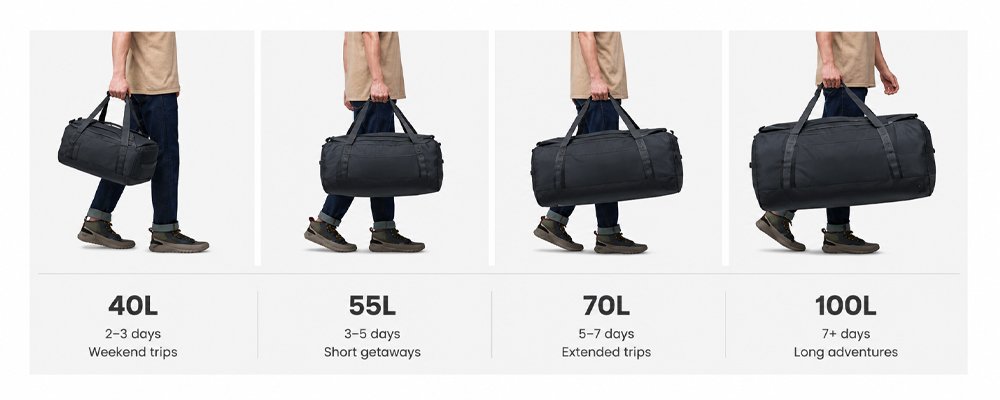
- 20-30L small duffel bags are suitable for gym and daily activities.
- 30-50L medium duffel bags are ideal for weekend trips and short-distance travel.
- 50-90L large duffel bags are better suited for long-distance travel, outdoor activities, and equipment storage.
When marketing products, brands should use context appropriate to the bag type. For instance, one of our clients once marketed a 40L bag as an “extra-large duffel,” resulting in poor sales. When they rebranded it as a “weekend travel bag,” sales quadrupled within a month.
Small Travel Bags (Under 30L)
Duffel bags under 30L feature compact designs yet offer ample space for essentials. They are ideal for running errands or casual shopping trips. Additionally, most small duffel bags meet airline carry-on size requirements, making them perfect for traveling light. Small duffel bags are ideal for use as:
- Gym bags
- Weekend bags
- Day trip bags
- Work bags
- Business travel bags
- Promotional giveaways
Medium duffel bags (30–50L)
The duffel bag size range offers more packing space. For travel enthusiasts, a medium duffel is perfect for carrying 2–3 outfits, a spare pair of shoes, basic accessories, and a toiletry kit—all while remaining compact and easy to carry.
Some medium duffel bags qualify as carry-on luggage, but it is best to check the airline’s website to ensure the dimensions meet their requirements.
Medium duffel bags are ideal for:
- Weekend trips
- Short trips
- Outdoor sports
Large travel bags (50–90L)
Duffel bags above 50L are generally unsuitable for carry-on use and usually require checked baggage. Bags in the size range can hold supplies for a week-long trip or items for a family outing, and can even accommodate camping gear or adventure equipment.
Large duffel bags are suitable for:
- Long-distance travel
- Moving and storage
Duffel bags larger than 90L are less practical for everyday use but excel as heavy-duty transport or group travel bags. These rugged bags are typically made from highly durable materials with reinforced seams and bottoms, designed to withstand significant weight.
Fit Carry-on Duffel Bag Size Requirements By Airline
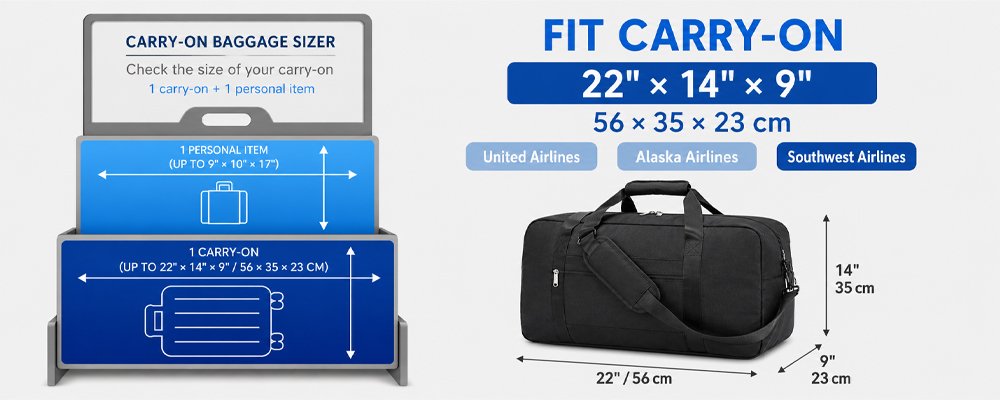
Most people looking to measure their duffel bag want to know one thing: “Can I take this bag directly onto the plane?”
As gate-side security checks become stricter, bags that might have previously squeaked through now often require checking. This not only wastes time but also incurs extra fees, ranging from $35 to $100.
We have compiled a reference table of common airline size restrictions for you to consult.
| Airline | Maximum Carry-on Size (L × W × H) | Inches | Weight Limit |
|---|---|---|---|
| United Airlines | 56 × 36 × 23 cm | 22 × 14 × 9 in | No specific limit (varies by route) |
| American Airlines | 56 × 36 × 23 cm | 22 × 14 × 9 in | No specific limit |
| Delta Air Lines | 56 × 35 × 23 cm | 22 × 14 × 9 in | No specific limit |
| Southwest Airlines | 61 × 41 × 25 cm | 24 × 16 × 10 in | No specific limit |
| British Airways | 56 × 45 × 25 cm | 22 × 18 × 10 in | Usually weight restricted |
| Lufthansa | 55 × 40 × 23 cm | 21.5 × 15.5 × 9 in | Usually up to 8 kg (varies by fare) |
| Ryanair | 55 × 40 × 20 cm (priority cabin bag) | 21.5 × 15.5 × 8 in | Up to 10 kg |
| Ryanair (Free Personal Item) | 40 × 30 × 20 cm | 16 × 12 × 8 in | — |
| EasyJet | 56 × 45 × 25 cm (large cabin bag) | 22 × 18 × 10 in | Usually up to 15 kg |
| Jet2 | 56 × 45 × 25 cm | 22 × 18 × 10 in | Up to 10 kg |
As an experienced custom duffel bag manufacturer, we strongly recommend that the carry-on duffel bags you develop do not exceed 21 x 13 x 8.5 inches. This allows for some margin to add external features like handles or pockets while ensuring compliance with most airlines’ size requirements. Additionally, soft-sided bags offer an advantage over hard-shell bags, as they can be compressed to fit into sizing bins.
How to Choose Custom Duffel Bags?
When selecting a custom carry-on bag, in addition to determining size and capacity, you should also consider factors such as materials, carrying style, and printing methods. Here are simple steps for selecting a custom duffel bag:
- Determine storage requirements, as this dictates the bag’s size.
- Select the capacity level. Small bags are suitable for essentials like a phone, wallet, and documents; medium bags accommodate shoes, 2–3 outfits, and a towel; large bags hold 3–4 outfits, two pairs of shoes, toiletries, a jacket, and gear.
- Choose the right material. Lightweight yet durable fabrics—such as polyester or nylon—are ideal for small bags, ensuring reliability while remaining portable. For travel, outdoor, or sports bags, tear-resistant fabrics are preferable to ensure load-bearing strength and abrasion resistance.
- Select a printing method. Printing allows for vibrant patterns at a lower cost, whereas embroidery or rubber applications offer a more three-dimensional, refined look that elevates the product’s aesthetic quality.
- Confirm logo placement. Ensure the brand logo is not obstructed by shoulder straps or stitching.
To reduce return rates for custom duffel bags, brands should—in addition to ensuring accurate capacity—incorporate the following construction details:
- Reinforce high-stress points such as handles, shoulder straps, and seams to prevent breakage during use.
- Select smooth, high-quality hardware (e.g., YKK zippers) to enhance the user experience.
- Use a sturdy base panel—especially for medium and large bags—to ensure proper structural support.
- Add interior lining or edge binding to effectively protect seams and increase durability.
FAQ
What is the best duffel bag size for a weekend trip?
A weekend trip requires at least three days’ worth of clothes, a spare pair of shoes, and toiletries, making a 40–50L duffel bag the most suitable choice. It offers sufficient storage space without feeling overly bulky to carry. If you keep the quantity and weight of your items in check, it can even serve as carry-on luggage.
What are the airline regulations for carry-on duffel bag Size?
Most airlines require carry-on duffel bags size to stay within 22 x 14 x 9 inches (56 x 36 x 23 cm) to ensure they fit in the overhead bin. Unlike hard-shell suitcases, soft-sided duffel bags can be compressed to some extent, making them easier to manage as carry-on luggage during security checks.
How do you measure the dimensions of an irregularly shaped duffel bag?
Since simple “length × width × height” calculations don’t work for irregularly shaped bags, manufacturers typically use a “bounding box” method to measure the maximum external dimensions. They then multiply this volume by a shape factor—ranging from 0.70 to 0.85, depending on how much the bag deviates from a standard rectangular shape—to provide a more accurate estimate of the bag’s actual capacity.
What duffel bag size should I buy for 8–9 day trips?
For an 8–9 day trip, a 90–100L duffel bag is ideal, as it provides ample space for all your belongings. Durable materials also ensure the bag withstands checked-luggage handling without damage, effectively protecting the items inside.